Wednesday, 7 April 2010

IBM breaks OSS patent promise, targets mainframe emulator

IBM is threatening to pursue legal action against TurboHercules, a company that sells services relating to the open source Hercules project, an emulator that allows conventional computers with mainstream operating systems to run software that is designed for IBM System Z mainframe hardware.

In a letter that IBM mainframe CTO Mark Anzani recently sent to TurboHercules, Big Blue says that it has "substantial concerns" that the Hercules project infringes on its patents. The letter is a brusque half-page, but was sent with nine additional pages that list a "non-exhaustive" selection of patents that IBM believes are infringed by the open source emulator.

This move earned the scorn of well-known free software advocate and patent reform activist, Florian Mueller. In a blog entry that was posted Tuesday, Mueller fiercely criticized IBM, accusing the company of abusing its patent portfolio and harming open source software in order to retain monopolistic control over its expensive mainframe offerings.

"After years of pretending to be a friend of Free and Open Source Software (FOSS), IBM now shows its true colors. IBM breaks the number one taboo of the FOSS community and shamelessly uses its patents against a well-respected FOSS project," wrote Mueller. "This proves that IBM's love for free and open source software ends where its business interests begin."

He contends that IBM's support for open source software is insincere. As evidence of the company's hypocrisy, Mueller points out that two of the patents that IBM listed in its letter to Hercules are included in the list of 500 patents that IBM promised to not assert against open source software in 2005. Mueller is convinced that the patent promise was a manipulative attempt to placate government regulators.

How emulation intersects with IBM's mainframe business

IBM's position in the mainframe market has posed contentious antitrust issues for years. The company's software licensing model ties its mainframe operating system to its underlying System Z hardware, guaranteeing that companies who have built their own applications for the platform can't easily migrate to other hardware options. This lock-in strategy has proved lucrative for IBM, generating billions of dollars in revenue.

Despite the extremely high cost and the fact that some companies don't necessarily derive value from the hardware's unique characteristics, they continue buying IBM's mainframe solutions because doing so remains cheaper than rewriting all of their legacy applications. We explained this phenomenon several years ago when we looked at the reasons why IBM's mainframe business is still profitable despite the declining relevance of the technology.

A well-designed System Z emulator that allows users to migrate their own mainframe applications to commodity hardware would obviously pose a serious threat to IBM's mainframe business, but IBM's software licensing terms have historically prevented such a threat from materializing. Users would have to run IBM's mainframe operating system inside of the Hercules emulator in order to run the applications—but they aren't allowed to do that.

It's certainly possible to run modern versions of IBM's mainframe operating system with Hercules, but it can't really be officially supported or publicly condoned by the project's developers due to the licensing issues. Much like Hackintoshing, it is fairly trivial on a technical level but constitutes an unambiguous violation of the end-user license agreement. As such, Hercules never really posed a threat to IBM in the past. The legal issues simply preclude commercial adoption and deployment in production environments. Hercules is principally used by enthusiasts to run z/Architecture Linux variants, an activity that doesn't erode IBM's lock-in strategy.

In many ways, the project arguably benefits IBM by encouraging interest in the mainframe platform. That is largely why IBM has shown no hostility towards Hercules in the past. In fact, IBM's own researchers and System Z specialists have lavished Hercules with praise over the years after using it themselves in various contexts. The project was even featured at one time in an IBM Redbook. What brought about IBM's change in perspective was an unexpected effort by the TurboHercules company to commercialize the project in some unusual ways.

TurboHercules came up with a bizarre method to circumvent the licensing restrictions and monetize the emulator. IBM allows customers to transfer the operating system license to another machine in the event that their mainframe suffers an outage. Depending on how you choose to interpret that part of the license, it could make it legally permissible to use IBM's mainframe operating system with Hercules in some cases.

Exploiting that loophole in the license, TurboHercules promotes the Hercules emulator as a "disaster recovery" solution that allows mainframe users to continue running their mainframe software on regular PC hardware when their mainframe is inoperable or experiencing technical problems. This has apparently opened up a market for commercial Hercules support with a modest number of potential customers, such as government entities that are required to have redundant failover systems for emergencies, but can't afford to buy a whole additional mainframe.

IBM's response

As you can probably imagine, IBM was not at all happy with that development. Following IBM's initial threats of legal action, Hercules retaliated by filing an antitrust motion in the European Union, calling for regulators to unbundle IBM's mainframe operating system from its mainframe hardware. IBM responded harshly last month, claiming that the antitrust motion is unfounded and that a software emulation business is just like selling cheap knock-offs of brand-name clothing. The conflict escalated, leading to the patent letter that was published on Tuesday.

When faced with patent litigation, companies often try to keep the conflict quiet and hope for an out-of-court settlement because they don't want the threat of a lawsuit to scare away potential customers. That's certainly a factor here, because IBM's threats raise serious questions about whether it is truly permissible to use the Hercules emulator in a commercial setting. TurboHercules is taking a bit of a risk by disclosing the letter to Mueller for broad publication. The startup likely chose to publicize their predicament with the hope that the open source software community will notice and respond by shaming IBM into backing down.

As Mueller points out in his blog entry, the broader open source software community has some reasons to side with TurboHercules in this dispute: some of the patents cited by IBM cover fundamental functionality of virtualization and emulation. Those patents reach far beyond the scope of Hercules and could pose a threat to other open source software projects.

Windstream in windstorm over ISP's search redirects

Responding to a medium-sized uproar, Windstream Communications says it is sorry about those customer searches performed by Firefox users and redirected from Google to its own search engine, and the Little Rock, Arkansas-based ISP has now got the situation under control.

"Windstream implemented a network change on Friday, April 2 that affected certain customer Web browser search box queries, producing search results inconsistent with Windstream's prior practices," a spokesperson for the voice/DSL service told us. "Windstream successfully implemented configuration changes today to restore original functionality to these search queries after hearing from affected customers."

The question, of course, is whether the company accidentally or deliberately rigged its network software to produce those "inconsistent" results. We asked, but not surprisingly didn't get an answer to that query.

Not the behavior I expect

As Ars readers know, there's money to be made from the typing errors of Web users. Input a slight misspelling of a popular domain name and you'll wind up at an ad-saturated site designed to harvest all such instances. Then there are the Internet service providers that take this business one step further. Screw up a domain by a single character and you wind up at an ISP-sponsored or -partnered search engine, complete with ads on the site waiting for your impression or click.

It appears that Windstream inadvertently or deliberately took this activity to the next level, according to its own statement and the complaints of some of its customers, reproduced on the Windstream forum page of DSL Reports. Here's one protest:

"Dear Windstream,
For future reference: When I use google via the firefox search bar I actually want to go to google not » searchredirect.windstream.net/
This redirect happens in both windows and linux even if dns is hard set in router and tcp/ip settings
It took me 45 minutes to figure out how to disable this 'feature'
» searchredirect.windstream.net/prefs.php you can disable this 'feature' here
Honestly this isn't the kind of behavior I expect out of my isp and I consider it very unprofessional."

To these forum concerns a Windstream support person initially posted this reply: "We apologize as this is an issue that we are aware of and are currently working to resolve. You should not be getting that redirect page when you are doing your searches. We should have this resolved soon." Next Windstream's Twitter page declared the problem is fixed: "Windstream has resolved unintentional issues with Firefox search. Apologies for the troubles you've had."

But this episode raises some serious worries, among them: how much should your ISP be allowed to monkey around with your Web browsing activity under any circumstances? Free Press has already called for the Federal Communications Commission to investigate this affair.

"If initial allegations are true, Windstream has crossed the line and is actively interfering with its subscribers' Internet communications," the reform groups' S. Derek Turner declared. "Hijacking a search query is not much different than deliberately ‘redirecting’ a user from NYTimes.com to WashingtonPost.com and a limited 'opt-out' capability is not enough to justify Internet discrimination. This is further proof of the need for strong open Internet rules, comprehensive transparency and disclosure obligations, and a process for relief at the FCC."

The issue has been resolved

Ars asked Windstream about these concerns. Not surprisingly, the ISP isn't crazy about the probe idea. "We don't think an investigation is necessary since the issue has been resolved," the company told Ars.

In truth, we'd be a bit surprised if the FCC jumped on this conundrum too quickly. Everybody's waiting to hear what the DC Circuit Court of Appeals has to say about the Commission's authority to sanction Comcast for P2P blocking, and most observers don't expect it to go well for the agency [update: the court has ruled]. As the Free Press statement suggests, the FCC's authority around these ISP issues is still a work in progress.

But given that ICANN has already condemned the practice of ISP redirection in the case of misspelled or nonexistent domain names, it doesn't seem like we've heard the last about this issue. Indeed, Windstream's quick response to subscriber complaints suggests the service knows that the watchdogs are watching. Windstream's latest repairs of its search system "do not require customers who chose to opt-out to do so again," the ISP assured us.

Court: FCC had no right to sanction Comcast for P2P blocking

The FCC's decision to sanction Comcast for its 2007 P2P blocking was overruled today by the US Court of Appeals for the DC Circuit. The question before the court was whether the FCC had the legal authority to "regulate an Internet service provider's network management practice." According to a three-judge panel, "the Commission has failed to make that showing" and the FCC's order against Comcast is tossed.

When the complaints against Comcast first surfaced, they noted that the company was violating the FCC's "Internet Policy Statement" drafted in 2005. That statement provided "four freedoms" to Internet users, including freedom from traffic discrimination apart from reasonable network management. The FCC decided that Comcast's actions had not been "reasonable network management," but Comcast took to the agency to court, arguing that the FCC had no right to regulate its network management practices at all.

The Internet Policy Statement was not a rule; instead, it was a set of guidelines, and even the statement admitted that the principles weren't legally enforceable. To sanction Comcast, the FCC relied on its "ancillary" jurisdiction to implement the authority that Congress gave it—but was this kind of network management ruling really within the FCC's remit?

The court held that it wasn't, that Congress had never given the agency the authority necessary to do this, and that the entire proceeding was illegitimate. The FCC's "Order" against Comcast is therefore vacated; Comcast wins.

The decision wasn't a surprise; during oral argument earlier this year, the judges pressed the FCC's top lawyer repeatedly. The Policy Statement was "aspirational, not operational," they said; the FCC had not identified a "specific statute" Comcast violated; and the FCC "can't get an unbridled, roving commission to go about doing good."

Comcast pledged some time ago to change the way it handled traffic management, and it has already transitioned to a protocol-agnostic approach to congestion.

Tuesday, 6 April 2010

Canonical announces phone sync for Ubuntu One subscribers

Canonical, the company behind the Ubuntu Linux distribution, announced today that its Ubuntu One cloud service will soon gain support for mobile contact synchronization. The feature will be available to users who are paying for the higher tier of Ubuntu One service.

Canonical officially launched the Ubuntu One service last year alongside the release of Ubuntu 9.10. The service allows users to keep files and some application data synchronized between multiple computers. The company is planning to roll out several significant new Ubuntu One features when Ubuntu 10.04, codenamed Lucid Lynx, is released later this month. The new Ubuntu One music store, which is integrated into the Rhythmbox audio player, will use Ubuntu One to deploy purchased music to all of the user's computers. Much like the music store, the new mobile synchronization features are opening up for testing, but will officially launch alongside Ubuntu 10.04.

Ubuntu One mobile synchronization is powered by Funambol, a mobile push synchronization platform that is partly distributed under open source software licenses. Ubuntu One contact synchronization will work on the wide range of devices that are supported by Funambol's client software. You can download the synchronization program for your specific device by selecting it at the beta phone page on the Ubuntu One website.

Canonical is also releasing its own branded Funambol-based mobile client applications for certain platforms. For example, the company is offering an Ubuntu One contact synchronization program for the iPhone, which is now available from the iTunes stores. Plugins are available for several desktop applications too, such as Thunderbird.

The underlying Funambol technology supports push synchronization for calendars, notes, and other kinds of data, but Ubuntu One's mobile sync only supports contacts at the present time. It's possible that its scope will be expanded as the service evolves.

Canonical developer Martin Albisetti described the new mobile sync feature in an announcement today on the Ubuntu One users mailing list.

"Getting contacts on CouchDB and replicating between desktops and the cloud was the first big step. The second, and much bigger step, is to actually get those contacts from and to mobile phones. To achieve this, we have partnered with a company called Funambol, who share our views on open source, and have an established a proven software stack that synchronizes thousands of mobile phones and other devices," Albisetti wrote. "Right now we're at a stage where we feel confident opening up the service for wider testing. We strongly recommend that [testers] have a backup of [their] contacts since we've only tested with a hand-full of phone models at this point."

Although the service is intended for paying Ubuntu One customers, nonsubscribers will get an opportunity to test it for free during a 30-day trial period. Albisetti says that the free trial will start following the release of Ubuntu 10.04. Right now, Canonical is seeking help from the user community to test the service. He encourages users to provide feedback in the #ubuntuone IRC channel and on the Ubuntu One mailing list.

When we reviewed Ubuntu 9.10 last year, we noted that the lack of mobile synchronization was one of the most glaring deficiencies of the Ubuntu One service. Many users already get contact synchronization for free through Google and other providers, but the feature could still potentially help make an Ubuntu One paid plan seem compelling to some regular end users.

HP Slate pricing and specs leak: Atom CPU, 1080p video

It looks like HP employees have been given an internal HP Slate presentation comparing it to the Apple iPad, according to a slide obtained by Engadget. The device will cost either $549 for the 32GB flash storage version or $599 version for the 64GB version.

Both versions sport a 8.9-" 1024 x 600 capacitive multitouch display, a 1.6GHz Atom Z530 processor with UMA graphics, an accelerator for 1080p video playback, and 1GB of non-upgradeable RAM. They'll also include a two-cell five-hour battery, an SDHC slot, two cameras, a USB port, a SIM card slot for the optional 3G modem, and a dock connector for power, audio, and HDMI out. The included Windows 7 edition will be Home Premium.

Those are the unofficial details, anyway. Three months ago, HP went on record to explain how the project started and gave some vague details on the product: thin, light, somewhere between 4 to 10 inches, and be able take on the e-reader market, currently dominated by Sony and Amazon, head on. 2010 is the year for slates, HP said, and that's thanks to a convergence of low-cost and low-power processors as well as the touch-aware Windows 7. The company would only confirm that the tablet would be out this year, would be running Microsoft's latest and greatest, and will cost you less than $1,500.

The questions that have yet to be answered either by HP or by rumors are mainly around what software it will feature and how exactly Windows 7 will be customized to work on the slate (though the slide does mention "HP touch-optimized UI").

HTML5 and WebGL bring Quake to the browser

The developers behind the GWT Java framework have implemented a port of Quake 2 that runs natively in modern Web browsers. It takes advantage of recent innovations in emerging standards-based Web technologies such as WebGL and WebSockets.

GWT is designed to enable Web application development with Java. Developers can benefit from Java's static typing and more rigidly structured architecture. It generates the requisite JavaScript code that is needed for the application's client-side components. GWT powers several high-profile Google Web applications, including Google Wave. The GWT developers implemented browser-based Quake by using a Java port of the Quake 2 engine on top of GWT.

GWT and the Java-based Quake engine both had to be extended and modified extensively in order for the pairing to work, but the effort paid off. It serves as a compelling example of how emerging standards are becoming increasingly capable of delivering all of the necessary functionality for interactive 3D network gaming.

As some readers might remember, Google released a Quake demo for Native Client (NaCl) when the plug-in was first announced in 2008. The state of open Web technologies has clearly advanced since that time. It's no longer necessary to rely on plugins to deliver this kind of functionality.

Monday, 5 April 2010

It looks like time to build an Atlantic seaboard wind grid

One of the greatest challenges of integrating renewable power into the US grid is its intermittent nature. This is especially true for wind power, which is prone to rapid fluctuations that can leave utilities scrambling to either add or dump power. But the temptation of wind is large—the US has wind resources to cover 23 times its current electric use—and that has led to many ideas about how best to deal with the erratic supply. A study that will appear in PNAS later this week suggests a radical solution: connect offshore wind up the entire Eastern Seaboard of the US into a single, huge, baseline generating system.

The authors of the new study note that, currently at least, the fluctuations in wind power are handled by redundant generating and transmission equipment, which generally involves the burning of fossil fuels when the wind slacks off. One of the two major alternatives currently under consideration involves the use of energy storage, either large, on-grid facilities, or ad-hoc aggregation of the excess capacity in items like electric vehicles. The final option, and the one they consider, is the potential to aggregate geographically diverse collections of wind farms.

They're hardly the first to consider this prospect, and a variety of other studies have examined the potential of distributed wind in specific locations. So, for example, a study of wind potential in the UK found a tendency for the entire geographic area to experience similar wind conditions, meaning that even a dispersed generating system might not work there.

The new study builds on the earlier work by considering why this is the case. The UK is about 1,100km along its north-south axis, and the high pressure systems that bring it low wind tend to be roughly 1,000km in size. In contrast, the US East coast is roughly 2,500km in length, and has a tendency to spawn storms that move up the coast in a roughly northeasterly direction. Many states along the coast are already in the planning or permitting stages for large offshore wind facilities (New Jersey alone is considering at least three) that will total over a TeraWatt in capacity, assuming they're all built.

So, for the new analysis, the authors considered a total of 11 sites on the continental shelf, ranging from the Florida Keys to the Gulf of Maine. Wind speed data was available over a five-year period for each of the sites, available with one-hour resolution between readings.

As expected, sites close to each other showed a fair degree of correlation in wind speeds—if the winds had died at one, they were likely to be dead at a site that was relatively nearby. By the time sites 750km apart were considered, however, the correlation had dropped below 0.2, and it dropped below 0.1 for sites over 1,300km apart. As expected, this means that the large geographic spread of the sites means that they're unlikely to be hit by a single weather system that causes a synchronized rise or fall in production.

The authors didn't seem much in the way of negative correlations, however, where a lack of wind in one site would typically mean high winds in a different one. Still, the aggregated wind power was very stable. Although production from individual sites would rise and fall by as much as 50 percent within an hour, the aggregate as a whole rarely saw changes greater than 10 percent. Throughout the entire period, the ensemble was above 5 percent of its rated capacity except for a grand total of 20 days, and never dropped to zero. For the most part, output was typically near the middle of the capacity range.

The authors also analyzed individual weather events, including one where a large anticyclonic system was parked over North Carolina. Although the center of the seaboard was largely quiet, stations in Florida saw strong westward winds, while those in New England had a strong eastward wind, exactly as the authors had predicted. All 20 days of low production were analyzed, but the authors conclude there's no pattern involved; each of the instances was the product of unique circumstances.

The authors seem rather interested in the idea of actually physically connecting all the sites with high-capacity undersea cables into what they term the Atlantic Transmission Grid. At roughly $4 million a mile to install, this would still account for less than 15 percent of the total price of the full system of wind farms, a figure that's in line with building redundant generating capacity onshore. Still, there would seem to be advantages to building the interconnect on land, where it would be easier to service and could integrate other intermittent power sources, like solar.

There's also a certain irony to the fact that the authors suggest that planning and licensing the Atlantic Transmissions Grid would be simpler because it involves a single nation. While that's true to an extent, the grid would have to service a patchwork of local utilities, and incorporate sites in states that have very different perspectives on (and legislated requirements for) renewable power.

New server platform and 12-core Opteron keep AMD in the game

The x86 server wars heated up significantly in March, with the end of the month seeing a major processor launch from each vendor: AMD launched its 12-core Opteron 6100 processor, codenamed Magny-Cours, on the 29th, and Intel then finished off the month with the launch of the 8-core Nehalem EX Xeons.

These were pretty major launches, but I've covered Nehalem EX previously so I want to focus on AMD this time around.

AMD actually launched ten different processors at a range of clockspeeds (1.7 to 2.3GHz) and core counts (8 and 12); all of these parts make up the Opteron 6000 series, which is aimed at two- and four-socket configurations. These two configs represent the bulk of the server market, and AMD is aiming to be the value player here.

In terms of microarchitecture, the new Opterons don't differ significantly from their predecessors, or indeed from the previous few generations. The addition of support for virtualized I/O is the main change a the core level, a change that brings AMD up to par with Intel's Nehalem parts in their level of virtualization support.

At the level of what I'd like to call "macroarchitecture"—meaning the arrangement of cores, I/O, cache, and other resources on the processor die—there are some significant improvements.

The shared cache for the 8-core parts is 17.1MB, while the 12-core weighs in at 19.6MB.

On the memory front, the new Opterons boast support for four channels of DDR3—that's a lot of aggregate memory bandwidth across two or four sockets. For I/O, each package has four HT 3.0 (x16) links; this amount of I/O bandwidth is needed because there are so many cores per socket. In fact, moving out to the system level, you can see where AMD put most of its engineering effort.

DirectConnect 2.0

One of the key ways that AMD is amping up the bang-per-buck is by taking a route that it had previously made fun of Intel for: sandwiching two n-core dies into a single package (a multichip module, or MCM) and calling the resulting part a 2n-core processor. The 12-core is two six-core dies, and the 8-core part is two four-core dies (actually, it's two six-core dies with some cores disabled, an approach that helps get yields up and costs down).

Back when Intel started doing this MCM-based multicore approach in the waning days of the Pentium 4 era, its impact on system architecture was a lot more straightforward. But AMD's NUMA system architecture, where the on-die memory controller means that the memory pool is distributed among all the sockets in a multisocket system, complicates the MCM approach. This is because the number of NUMA nodes no longer equals the number of sockets. AMD's answer to this problem is called Direct Connect 2.0.

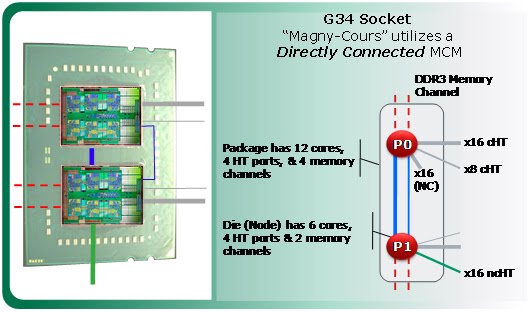
Take a look at the diagram below, which shows the I/O and memory buses in the Magny-Cours part. You can see that each individual Magny Cours die (or "node," from the perspective of NUMA topology) has two memory controllers and four HT 3.0 controllers.


The two memory controllers on each die connect directly to the pool of DDR3 that hangs off of each socket, which gives each socket its four total DDR3 lanes.

The way the HT link bandwidth is divided up in a two-socket config is a little non-obvious, but you can see what's going on from the diagram. The controllers split the link bandwidth for each die/node into three x16 links and two x8 links. One of the x8 and one of the x16 are then combined to make what's essentially an x24 link, which is used for directly connecting the two dies that are in the same package.

Another x16 link goes out to connect to the first die in the other socket, and the remaining x8 link connects diagonally to the second die in the other socket. The fourth remaining x16 link on one of the dies is not connected to anything, and on the other die it's used for I/O. The diagram at right attempts to illustrate how this works—it's not great, but if you stare at it for a minute it makes sense.

What's new about Direct Connect 2.0 (as opposed to Istanbul's 1.0 version) are the diagonal links, which let each node connect to two other nodes. Direct Connect 1.0 was missing the diagonal links, so if memory was in the wrong pool a node might have to make two hops to get it, instead of just one. Of course, the diagonal links are half the bandwidth of the regular links, but you can't have everything.

With so many cores per socket, congestion is still going to be a problem, despite the four HT 3.0 links per node. This being the case, AMD uses a technology called HT Assist to reduce inter-core traffic by cutting back on cache snoops among the sockets, so that helps mitigate some of the traffic congestion that could crop up with all of those cores and off-die links.

Despite the drawbacks of the MCM approach, Intel proved with its own dual-die products that the strategy works, especially if you're targeting cost and not just raw performance. MCMs are also great for when you want to pack a lot of compute power into a smaller, cheaper system, and you're willing to compromise a bit on the memory performance for certain kinds of latency-sensitive, write-intensive workloads. Specifically, Magny-Cours should make for a great HPC platform, because it offers a lot of plenty of hardware per socket, per dollar, and per watt, and that's just what you need to put together a cluster of machines that can grind through heavily data-parallel workloads.

Databases are probably a different story, especially when you compare Magny-Cours to Nehalem EX's buffer-enabled memory subsystem, which lets you cheaply cram loads of memory onto each socket. It's also the case that these types of workloads tend to have more coherency traffic, because different nodes may be accessing the same region of memory. In this case, the balance may tip in Intel's favor.

In all, though, the Magny-Cours launch is a huge one for AMD, and its platform-level innovations like Direct Connect 2.0, support for virtualized I/O, power efficiency, and relatively low cost should keep AMD in the server game. And staying in the server game has been AMD's number one survival priority in the past two years. I pointed out at the end of 2009 just how much other business AMD has thrown overboard as the company shrank back into its core x86 server and GPU businesses, and this new server platform reflects that single-minded focus. AMD's processors may not have the raw per-core performance that Intel's Nehalem boasts, but the company is doing a lot at the macroarchitecture and system architecture levels to narrow that gap.

Google fiber losers, unite! (And then build your own network)

Now that Google has wrapped up the application period for its open access, 1Gbps fiber testbed, we know that more than 1,000 US cities want the network. Only a couple will get it, though; what's going to happen to everyone else?

Broadband consultant Craig Settles and Greensboro, North Carolina fiber booster Jay Ovittore have joined forces to start "Communities United for Broadband." The idea is simple: create a place where communities can share strategies for moving forward with high-speed broadband plans—even if Google says no to their bid.

Pent-up demand

Enthusiasm about broadband has been running high, especially during the last 18 months. In 2009, President Obama's stimulus bill set aside billions for broadband. That money, now being dispersed, is already funding plenty of regional and middle-mile projects, and it encouraged communities to think more carefully about how broadband could be made better. Then came the National Broadband Plan, which has inspired broadband discussion over the last year and now promotes some major changes like providing Universal Service Fund money to broadband providers instead of phone companies.

But no local mayor jumped in a shark tank or changed its city's name to get federal broadband stimulus funds. It took Google's out-of-the-blue announcement earlier this year to really bring broadband excitement from governments down to the grassroots level. With so much enthusiasm generated by the project, and with cities having spent so much time to collect all sorts of useful data about their own communities, now would seem the perfect opportunity for people to take their broadband destiny into their own hands—with or without Google.

That's what Settles and Ottivore hope to do. They're starting with a Facebook group to coordinate broadband boosters around the country. Already, a few hundred people have signed on, among them many local administrators of the Google fiber bids.

Google's project really "brought into focus what the value of broadband is," Settles tells Ars. Even before the project has been built, Google's announcement has woken people up to what's possible; maximum speeds of 6Mbps from a local DSL provider simply aren't state-of-the-art. People want more, they know it's possible, but many see no way to get it from existing providers.

Everyone wanted a piece of the Google action because the company was ready to build the network itself, pledging to charge users quite reasonable rates for access. But if municipalities or regional governments are going to get into the fiber-building game, that's a different and much scarier proposition, with real tax money on the table.

Settles is no stranger to these issues, having just written a book called Fighting the Next Good Fight: Bringing true broadband to your community, but he says that "we're not in the pitchfork business" when it comes to dealing with incumbents. If existing companies will provide the services that local residents want, fine. If communities can use the recent wave of broadband excitement to encourage new entrants or nonprofits to deploy fiber, terrific. But if no one steps up to the plate, Settles encourages local governments to take the initiative themselves.

"I believe incumbents are unaware of, or unconcerned with, the depth of people’s dislike for their service provider as well as the lack of broadband competition," he said in the official announcement. "The fact that, spending almost no money and making no concrete offers, Google generated so many community and individual responses within just seven weeks clearly shows how much incumbents have failed the market. Our effort on Facebook gives communities one path to helping correct this failure."

The page is already stimulating discussion. When one participant asked about starting a "fiber co-op, akin to the farmer's co-ops, that allows cities to band together for bargaining purposes and equipment purchases," another person offered to talk, saying, "We are already down this road and would love to help others along in other communities."

As Settles noted in our conversation, there aren't many "best practices" in this area. What works? What doesn't? Certainly, as municipal involvement with free WiFi a few years back showed us, there are good ways and bad ways to get governments involved in infrastructure buildouts. Sharing information, pooling resources, and grouping buying power should help, though Google could certainly do its part by producing detailed best practices guides for ISPs based on its own experience building the 1Gbps testbed.

Last week, Google seemed to hint at just such a plan. "Wherever we decide to build," the company wrote, "we hope to learn lessons that will help improve Internet access everywhere. After all, you shouldn't have to jump into frozen lakes and shark tanks to get ultra high-speed broadband."

Saturday, 3 April 2010

Top broadcast journalism prize goes to... a website?

When most folks think about George Foster Peabody awards for distinguished broadcast journalism, famous recipients like Edward R. Murrow or the Frontline TV series come to mind. Certainly the vast majority of Peabody picks are either people or programs. But the latest winners, announced on Wednesday, include a website: National Public Radio's "topically boundless counterpart," as Peabody calls it. Everybody else knows the site as npr.org.

"A whole lot of things considered, from 'South Park' to North Korea, make this one of the great one-stop websites," Peabody adds. Needless to say, the suits over at the service are tickled pink by this prize.

"For all of us, today's awards speak to NPR's ability to adapt and grow while continuing to tell stories and create new online features that serve your needs and interests," NPR Vice Presidents Ellen Weiss and Kinsey Wilson declared on the network's blog.

Indeed, npr.org is quite something. You can get the latest news, or hourly news, access a slew of music, listen to concerts, tune into all your favorite NPR shows, follow dozens of interviews, stick NPR widgets on your desktop, listen to great features about culture, find your local NPR station, or growl at NPR's ombudsman, Alicia Shepard, all on one easy to navigate portal.

And the entire site comes—dare we say it—without commercial Web ads (save for NPR donation widgets and the NPR Shop, of course).

But this award reflects more than the appeal and usefulness of NPR's website. We think it's recognition that NPR represents one of broadcast radio's few success stories over the last decade.

Radio survivor

The master narrative of radio was brutally but accurately summarized by a Boston Globe market survey report in 2005: "On Demand Killed the Radio Star—How Satellite Radio, the Internet, Podcasting and MP3 Players Are Changing the Terrestrial Radio Landscape." Add to that the foolhardy broadcasting mergers which followed the Telecom Act of 1996, mix in this nasty recession, and you wind up with train wrecks like Citadel media, the nation's third biggest broadcaster, whose shares closed at 1.6 cents last December following the company's bankruptcy announcement.

NPR has not only survived all this, but compared to the rest of the pack, the network is thriving. The service saw a huge boost in its listenership during the 2008 election—a 7% jump, bringing the audience to 27.5 million listeners weekly. At present, a third of the nation's FM radio stations are classified as "educational," and over 900 of those are either NPR affiliate stations or run some NPR programming.

On top of this, NPR has pursued an aggressive Internet and mobile broadband strategy, with a terrific Public Radio Player for the iPhone, which now has 2.5 million subscribers. You can reach hundreds of public radio stations with the app, picking and choosing which show you want to listen to and when, or opting for demand streams that can be accessed at any time.

Plus there's a mobile NPR.org (m.npr.org), and an NPR news app for the Android. It allows for backgrounding, so users can access other applications while tuning into headlines. And of course since it's an Android, the code is open source.

And last week, NPR released a new read-write API that will allow other media services to post content to NPR as well as receive it. The first participants in this experiment include Oregon Public Broadcasting and the Northwest News Network, followed by KQED in San Francisco, WBUR in Boston, and WXPN in Philadelphia.

More to come

Such is NPR's zeal for keeping up with the cyberJoneses that the network is promising that it will be completely iPad compatible when said famous device is released by Apple on April 3.

"From day one, iPad users who visit the NPR website will get an experience that is optimized for the device," the Inside NPR blog pledges. "Features like the NPR audio player have been given greater visibility and adapted for the unique technical requirements of this new platform; we've modified the navigation and made the site more 'touch' friendly; and we've improved the sponsorship experience—all without changing the main site."

Proactive, adaptive, and imaginative, public radio is keeping radio alive. Congratulations to npr.org.

Ubuntu 10.10 to be codenamed Maverick Meerkat

Ubuntu 10.04, codenamed Lucid Lynx, is scheduled for release this month. The developers at Canonical, the company behind the Ubuntu Linux distribution, have already started the process of planning for the next major release. Founder Mark Shuttleworth revealed today in a blog entry that Ubuntu 10.10, which is scheduled to arrive in October, will be codenamed Moribund Moth Maverick Meerkat.

Ubuntu 10.04 is a long-term support release, which means that the focus during the current development cycle has largely been on stabilization and refining the existing technology. Shuttleworth says that we can expect to see a return to experimentation in the 10.10 release, with the potential for some radical changes.

Some of the most important goals include delivering a new Ubuntu Netbook Edition user interface, improving the Web experience, boosting startup performance, and extending social network integration on the desktop. Shuttleworth also hopes to advance Ubuntu's cloud support by simplifying deployment and making it easier to manage cloud computing workloads.

The meerkat was chosen as the mascot for the new version because the creature embodies some of the key values that will influence the coming development cycle.

"This is a time of change, and we're not afraid to surprise people with a bold move if the opportunity for dramatic improvement presents itself. We want to put Ubuntu and free software on every single consumer PC that ships from a major manufacturer, the ultimate maverick move," Shuttleworth wrote in the announcement. "Meerkats are, of course, light, fast and social—everything we want in a Perfect 10."

Canonical's staff, Ubuntu contributors, third-party application developers, and members of various upstream communities will gather in Belgium next month for the Ubuntu Developer Summit (UDS), an event that takes place near the beginning of each new Ubuntu development cycle. This event provides a venue for planning the details of the next major version of the distribution. More specific details about the Maverick roadmap will be available after the event.

Ubuntu 10.10 will coincide with the launch of GNOME 3, a major overhaul of the open source desktop environment that provides significant parts of the Ubuntu user experience. Shuttleworth's statements about bold moves and opportunities for dramatic improvement suggest that we could potentially see Ubuntu adopt the new GNOME Shell if it proves suitable. It's possible that we could also see the new default theme evolve and benefit from experimental features that were deferred during this cycle, such as RGBA colormaps and client-side window decorations.

The upcoming 10.04 release is looking really impressieve. Users can expect to see even more progress as the Malodorous Mongoose Maverick Meerkat begins to take shape. As usual, we invite our readers to share their most humorous alternate codename suggestions in the discussion thread.

IBM initiative aims to hook startups while they're young

Vendor lock-in gets a bad wrap, especially when it comes to the cloud. Users may complain about it, and IT administrators may eye cloud platforms with distrust on account of it, but lock-in is one of the core tradeoffs that clients make in return for access to scalable, flexible cloud services. And that lock-in provides some security for service providers who are taking on the considerable infrastructure cost that building a cloud platform entails. That’s why IBM is now cultivating lock-in by adopting a version of the same strategy Microsoft used in the '80s and '90s to establish the Windows and Office monopolies—give away the product (in Microsoft’s case, by turning a blind eye to rampant piracy), so that your user base is locked in by the time you get really serious about charging.

That looks to be the motive behind IBM’s Global Entrepreneur initiative, which promises early-stage startups free use of specific IBM cloud services, as well as access to the kind of sales, marketing, and technical expertise that Big Blue’s growing and hugely successful services arm typically charges big bucks for. Check out the roster of goodies for startups that are accepted to the program:

Under the new initiative, start-ups can for the first time:
  • access IBM's software portfolio through a cloud computing environment, including IBM industry frameworks to accelerate software development;
  • work side-by-side with scientists and technology experts from IBM Research to develop new technologies;
  • take advantage of dedicated IBM project managers to assist in product development;
  • attend new IBM SmartCamp mentoring and networking workshops with VC firms, government leaders, academics, and industry experts at the global network of 40 IBMInnovation Centers to build business and go-to-market plans;
  • tap a new social networking community on IBM developerWorks to connect with other entrepreneurs and more than eight million IT professionals from around the world.
And then, when your startup grows up, it will be very hard—if not completely impossible (more on this below)—to ditch IBM's platform for someone else's.

To qualify for the program, startups will need to be less than three years old, privately held, and "actively developing software aligned to IBM's Smarter Planet focus areas." IBM is partnering with 19 associations and VC groups in different parts of the world in order to identify startups and attract them to the initiative.

All told, anything that gets promising, early-stage companies to build their software directly to IBM's cloud is great for IBM—and the fact that these companies will also get a free taste of IBM's consulting services is an added bonus. But is it good for the startups?

The answer to that latter question depends entirely on how good IBM's cloud offerings are, and not so much on the fact of the lock-in itself. That's because lock-in is a defining feature of the cloud landscape, and when you decide to use cloud services either as a consumer or a company, you have to go in with your eyes open.

Lock-in goes with the territory

The issue of lock-in comes up enough in discussions of the cloud that it's worth recapping how it works for readers who don't follow the topic as closely.

In a nutshell, cloud services are offered at three levels of abstraction, and the higher up you go on the abstraction ladder, the more you're locked in to a specific vendor's offering.

The lowest level with the least lock-in is infrastructure-as-a-service (IaaS). A great example is Amazon's EC2, which lets you cheaply and quickly get metered access to any number of virtual Windows or Linux machines. If at some point you decide you don't like EC2, you could always host identically configured VMs on your own in-house hardware, and ditch Amazon's platform entirely.

At the next level up are platform-as-a-service (PaaS) offerings like Google App Engine. It's at this level that the real lock-in starts. If you build our application on App Engine, then it's an App Engine application. And if Google's platform goes down, as it has done once already this year, then so does your app. Or, if you decide you hate Google and want to switch, you'll have to rewrite the app.

At the topmost level of abstraction is software-as-a-service (SaaS), the most commonly cited examples of which are Salesforce.com and SugarCRM. These are cloud applications that you pay to access, and they've got your data siloed away in their cloud. For some SaaS apps, like Google Docs, you could conceivably get your data back out, but it's a pain. SaaS platforms are designed to ingest data and keep it, not to spit it back out in an easily portable format (though there's a movement afoot to change that).

Ultimately, lock-in will be a prominent feature of the cloud landscape from here on out, and more companies will follow IBM's strategy of actively targeting early-stage software startups in order to hook them on a specific platform. This isn't necessarily a bad thing or a good thing—it's just one more technological trade-off to juggle. So it's up to cloud users to educate themselves about the amount of lock-in that they'll be subject to when they commit to any cloud platform, and to factor that into their decision. If lock-in is a serious concern for you, then you'll have to be extremely careful about the kinds of cloud services you pick, and about how you use those services.

FCC photos reveal iPad internals, sculpted aluminum case


The Federal Communications Commission beat iFixit to the punch in publishing the first iPad take-apart photos, although the Commission did have an unfair advantage since it got pre-launch access to the device for its usual RF testing. The photos do give a first look at the iPad's laser sculpted aluminum casing as well as a little detail about how the hardware is put together.

What's not surprising is that most of the internal volume us taken up by two large Li-Ion batteries. The logic board is tiny and appears to be not much bigger than an iPhone. All of the internal components are jammed in there good and tight, as one might imagine. But what's most surprising is that there is actually a good amount of empty space inside.


Lest you think iFixit took this challenge lying down, however, the company craftily removed the FCC's meager attempts to cover up details of the chips that Apple requested the FCC keep "confidential." iFixit analyzed the source of the components, but none of them are major surprises so far. There's an Apple A4 processor, Toshiba flash memory, and Broadcom radio chips. The IPS display panel is also suspected to be made by LG Phillips.

Some of the components are too small to make out in the relatively low-resolution images, and some of the components might be slightly different in the actual shipping version. iFixit promises have a more detailed analysis after receiving its own iPad.

Friday, 2 April 2010

Report: Apple purchases another processor design house

Apple's gigantic bankroll may be burning a hole in its pocket. Almost two years after purchasing PowerPC designer P.A. Semi, Apple appears to have snapped up ARM design house Intrinsity. According to a report that first appeared on EDN (via electronista), a number of engineers at the company have indicated that they are now or soon will be employed by Apple. Some of them have even gone as far as to change their LinkedIn profiles, with one reverting it—possibly out of fear of drawing the wrath of his new, secretive employer.

Intrinsity is known for its expertise with ARM processors such as the one used in the iPad. The design house has always been fairly quiet about its client list, so it's quite possible that Intrinsity contributed as much, if not more to the A4 ARM processor that powers the iPad than did P.A. Semi. Intrinsity has done work on customized Cortex A8 processors for the likes of Samsung, so the company's expertise in the area would be extremely attractive to Apple.

If the sudden disappearance of Intrinsity's web site is truly an indication that Apple has made another purchase, it's a clear sign that Cupertino has really big plans for ARM and doesn't see a future for x86 outside of its desktops and laptops. In addition to powering iPads and iPhones, it's possible that we could see Apple-created ARM chips in other consumer devices—even HDTVs—if Apple wants to try and stake out more consumer electronics turf.

How the fake "iCade" could become a reality for the iPad


Games are big on the iPhone—the majority of apps on the App Store are games, and games are regularly among the top-selling paid and free apps. With the iPad, gaming on Apple's mobile devices is poised to get even bigger (pardon the pun). But even with the touchscreen and accelerometer inputs, some games just need more traditional D-pad or joystick controls. The question is, why aren't third-party accessories available to give us this control?

Apple itself may be getting into the gaming accessory business, if the details of a recently published patent application are any indication. A group of emulator enthusiasts has already started limited production of a similar accessory for the iPhone and iPod touch. And, a fake gaming accessory from ThinkGeek has caused a major buzz on the Internet, enough that the company may be considering turning it into a real product.

Apple has filed a patent application, published today, for an "Accessory for Playing Games with a Portable Electronic Device." The patent was originally filed in September 2008, so clearly Apple has given thought to this issue. The patent describes a device that a "portable electronic device," such as an iPhone or iPad could slip into, and offer a user "a plurality of input controls that may be actuated by a user while playing a game." The illustrations that accompany the patent clearly show an iPhone-like device connecting to the accessory via a dock connector.

The accessory could include any of the following: buttons, D-pad, joystick, a keypad, microphone, camera, speakers, and even a secondary display. The device could also offer a number of gaming related features, such as force feedback or streaming of video or audio to external devices. Apple also suggests it could include integrated memory for storing your "game progress."

Apple isn't the only one to be thinking along these lines. In May 2008, a group of hackers modified a SNES controller to work with a jailbroken iPhone over a serial connection, and built a prototype of what is now known as the iControlPad. The device is akin to a bulky iPhone case that adds a D-pad and four buttons that could be used to control games.

Over the last two years a few prototypes were made as the iControlPad was refined, and now a finalized version is being manufactured in limited quantities in the UK. One version even includes a built-in rechargeable battery to power an iPhone or iPod touch for "marathon gaming sesions." (I would buy one just to play Space Miner without having to recharge every eight hours.) There is also an SDK that developers can use to add support to the games they make. The only problem is that it will only work with games made for jailbroken iPhones or iPod touches—the numerous games from the App Store just won't work.

The problem isn't technological, though. Apple added an API in iPhone OS 3.0 to let accessories connected via the Dock connector to communicate with an app. Unfortunately, making such an accessory means a company must join Apple's "Made for iPod" program, which means negotiating a licensing fee to gain access to both the API as well as the necessary chips that must be included to "authorize" accessories to connect to an iPhone, iPod touch, or even the iPad. The cost alone can be prohibitive, and only a few accessories have been produced so far.

Another roadblock is that the current implementation of the accessory API limits a device to communicating with only one app. Even if App Store developers wanted to add iControlPad support to their games, so far they wouldn't be able to. (This misstep doesn't just affect gaming accessories, either—generalized sensors could be made for a variety of scientific applications, for instance.)

These roadblocks could also prevent products such as ThinkGeek's iCade from ever becoming a reality. The iCade purports to be a miniature classic arcade cabinet that you slide an iPad into. The cabinet includes stereo speakers and a classic joystick and buttons, which, when coupled with the iPad's large screen, would make for the ultimate retro gaming device. The iCade would interface via the Dock connector with an iPad version of the MAME arcade emulator, allowing anyone to live out their own King of Kong kill-screen fantasies.

Though the product is actually a clever (and cruel) April Fool's joke, Ty Liotta, ThinkGeek's merchandising manager and head of custom product design, told Ars that it could very well end up being a real product. "People would really like to buy it, and we have had many people e-mailing and requesting it be created," Liotta said. "Our customers know we have turned April Fools items into real products before, so they know there is the potential there."

Liotta was referring to one of last year's April Fools products, a sleeping bag that claimed to be made of the "exact synthetic compounds needed to re-create Tauntaun fur," ostensibly to keep you warm even in temperatures a low as those on the ice planet Hoth. ThinkGeek got so many requests to make the product that it secured a license from LucasFilm and had them manufactured. (Ars art director Aurich Lawson counts himself among the many proud owners.)

Though there are software licensing issues and the current limitations of the accessory API for iPhone OS, Liotta is hopeful that ThinkGeek could work with Apple and perhaps game developers to make the product a reality. "I did see a number of different products when I was at CES that use the Dock connector in all kinds of different ways," Liotta told Ars. "I didn't think we could convince Lucasfilm to let us make the Tauntaun sleeping bag and obviously that worked out."

Over 2,000 customers have signed up on ThinkGeek's website to be alerted whenever the iCade is available to order, and one customer even offered to fund 100 percent of the development costs to make the iCade a reality. Along with production of the iControlPad, it's clear that gamers are willing to pay to enhance the gaming experience on Apple's mobile devices.

Apple went through the trouble of filing a patent on a gaming accessory, but so far hasn't produced one of it's own. If Apple isn't interested in making one, it should be working with product developers to make building these accessories feasible and allowing developers to build support into their games.

Universal Service Fund: now with less incompetence!

The Federal Communications Commission's Universal Service Fund is cleaning up its act. Yes way—for real. And not only that, it looks like we've been a tad unkind to the benighted program in the past. Turns out that what seemed like a pretty devastating audit of one of the USF's main programs was way off in its calculations.

Here's the short version of that story. The USF, paid for by small tithes on your phone bill, runs four programs: a fund that subsidizes the phone bills of the poor; a program that subsidizes the computer/network needs of schools and libraries; another that underwrites broadband for rural health care facilities; and a division that offers financial support to rural carriers.

That last program is called the "high cost" fund. It helps with the challenges that rural carriers face in trying to provide service to relatively few consumers in spread out areas. Unfortunately, past audits of the fund have concluded that its high cost title has a second, less desirable meaning—a scarily huge error rate in payouts to carrier recipients: 16.6 percent, according to a review that the FCC's Inspector General released three years ago. A subsequent assessment warned that the program overpaid carriers by almost a billion dollars from July 2006 through June 2007.

But the Universal Service Administrative Company's new Annual Report includes a re-check of those numbers that calls them way too high. Not 16.6 percent for that first assessment, USAC says, just 2.7 percent. "USAC anticipates similar results in the final reports on the second and third rounds of the FCC OIG USF audit program," the Annual Report also notes.

Big fixups

Still, the document indicates the company has taken to heart many of the criticisms of the ways that it monitors its four programs. In mid-July of 2008 the Government Accountability Office warned that the FCC has not established meaningful performance goals for the USF. But the GAO reviews' most important finding was that nobody really audits the cost records of these telcos for, well, costs. FCC and USF data collection efforts only peer at a small percentage of recipients, GAO charged, and "generally focus on completeness and consistency of carriers' data submissions, but not the accuracy of the data." This could "facilitate excessive program expenditures," the report very politely concluded.

Now, in 2010, USAC will take a new approach, the company promises, "analyzing data from beneficiaries and from USAC to measure rates of improper payments and using a broad audit program to measure program compliance." The FCC has also established an interim cap on high cost fund payments to competitive carriers. And the low income program is completely revamping itself, with a new cost-tracking system to reduce accounting errors.

All this is good news, because the Universal Service Fund could become a huge engine for the expansion of broadband in the United States. Last year the USF paid out $7.3 billion to its recipients—money going out to 1,865 eligible telecommunications carriers in the case of the high cost program. But the balance of that cash went to phone service providers, not to ISPs.

So the FCC's National Broadband Plan recommends that Congress transitions USF money to two new programs. First, a Connect America Fund to support broadband providers for poor and rural regions. The CAF, as outlined in the Plan, is designed to avoid the errors of High Cost. It will only provide funding in zones "where there is no private sector business case to provide broadband and high-quality voice-grade service." The program will give to no more than one provider per area (as opposed to over a dozen in some present instances). Its recipients will be adequately audited. And, of course, they will have to provide broadband.

Second, the FCC wants Congress to launch a "mobility fund" to help various states get up to speed in 3G wireless.

All this could take a while for the House and Senate to get out the door. The FCC says this transition needs to happen by 2020, with reforms of High Cost and disbursements from Connect America both beginning in 2012. But the agency isn't waiting for Capitol Hill to get started. The Commission's next meeting, scheduled for April 21, will propose "common-sense reforms to the existing high-cost support mechanisms to identify funds that can be refocused toward broadband"—plus a Notice of Inquiry that asks for input on "the use of a model to determine efficient and targeted support levels for broadband deployment in high-cost areas."

Let's see how far the USAC and FCC can get on their own while waiting for Congress to take the big steps. Hopefully they won't have to tread water for too long.

Thursday, 1 April 2010

Apple reportedly tweaked the iPhone to work better on AT&T

Since the original iPhone launch, AT&T has put in motion a number of upgrades to its wireless network to accommodate the pounding it received at the collective fists of millions of iPhone users. But according to AT&T CTO John Donovan, Apple has also done its part to adjust the iPhone to work better on AT&T's network.

Donovan told the Wall Street Journal that, even as the company worked to convince Apple that it was improving its network, AT&T engineers went to Apple to give Apple's engineers a "crash course" in wireless networking. Apple modified how the iPhone communicates with towers to reduce the overhead for making connections or sending texts.

"They're well past networking 101, 201 or 301," Donovan told WSJ. Apple is now "in a Master's class."

Ars contacted both AT&T and Apple for further details about what was changed, but neither company offered any specific information. We do know, however, that the way the iPhone—as well as smartphones that came after it—use certain techniques for saving battery power that can bog down signaling channels on cell towers that aren't configured to handle signaling loads dynamically. The last we heard about significant changes in the 3G networking capabilities of the iPhone OS was in late 2008, though it's sure that Apple since tweaked the the network stack whenever needed.

AT&T learned that hard way that iPhone users didn't add network traffic in the same predictable patterns as users of other phones did. The company "is managing volumes that no one else has experienced," Donovan said. The growing pains that AT&T experienced as the iPhone skyrocketed to the top of the smartphone market in the US have left a number of users frustrated, with many willing to jump to another carrier if it could offer service for the iPhone. Half of Ars readers using an iPhone said they would switch to Verizon if a rumored CDMA-compatible iPhone materialized soon.

Verizon CTO Anthony Melone bragged late last year that the company was more than ready to handle the onslaught that iPhone users would bring to the network. "We are prepared to support that traffic," Melone told BusinessWeek.

That's easy to say, AT&T spokesperson Seth Bloom told Ars, "but the truth is no one knows what their network would look like if they had the iPhone." "Of course, it's true that others have been able to watch what we've done to handle a 5,000 percent surge in data traffic," Bloom added. "But watching is quite different from doing."

Bloom said that the upgrade to HSPA 7.2 and the added backhaul—"enough to also support our LTE buildout"—will keep AT&T ahead of the competition, which may be enough to keep iPhone users from looking at other carriers. "More and more people are going to get the benefits of 7.2 speeds this year on our network," he said.

Setting the record straight: no simple theory of everything

A bit over two years ago, news sources and science blogs lit up when a pre-print paper from Dr. A. Garrett Lisi came to light that proposed a novel theory of everything—one theory that accurately describes all four of the universes fundamental forces. Current theories have demonstrated that three of the four fundamental forces and their associated particles can all be obtained from different symmetry operations (think rotations and reflections) of an algebraic group called a Lie group The pre-print, hosted by the on-line repository arXiv, proposed that, within the complicated symmetry group E8, all four forces of nature could be described and united.

The hype that ensued (Google still suggests "surfer physicist" as a possible query) made this pre-print the most downloaded arXiv paper by March of 2008, and spawned an entire Wikipedia entry for the paper alone. As an engineer who specializes in theoretical work, it seemed to me to be a case of "give me enough parameters and I can fit a horse." Our in-Orbiting Headquarters physicist, Dr. Chris Lee, described it as solid, but noted it had some serious shortcomings.

In the intervening years, the paper—to the best of my knowledge and research ability—has not made it through peer-review to publication. A new paper, set to be published in an upcoming edition of Communications in Mathematical Physics, formally addresses the idea, and not only finds that Lisi's specific theory falls short, but that no theory based on the E8 symmetry group can possibly be a "Theory of Everything."

The new paper, which is also freely available as a preprint through the arXiv, is highly technical and lays out its case as a proof to a mathematical problem that attempts to define the criteria for a valid theory of everything. The authors begin by laying out three key criteria that a pair of subgroups on a Lie group must have in order to be a 'Theory of Everything.' The first is a trivial, yet purely mathematical, restriction that must hold true between the chosen sub-groups. The second is that the model cannot contain any "'exotic' higher-order spin particles." The final issue is that the gauge theory employed in our group must be chiral—a limitation dictated by the existing Standard Model.

In the original work by Lisi, it was proposed that the 248 dimensions of E8 corresponded to specific particles, either bosons or fermions—over 20 of which had yet to be discovered. The authors of the paper state that, in private communications, Dr. Lisi has backed off on this specific claim, and now states that only a subset of these dimensions represent actual particles. This modified version of the theory has yet to be publicly presented.

Going with the original version, one has to ask whether there is the correct amount of space within the potential subgroups to explain what we already know about. Math tells us that all the fermions—particles with half-integer spin—must come from what is known as the (-1)-eigenspace of the Lie group. Physics and math tell us that, in order to describe the known fermions, the subgroup of interest must have 180 dimensions.

Unfortunately, the (-1)-eigenspace on E8 (where the fermions must exist) has either 112 or 128 dimensions—too few to account for the known fermions. This goes directly against the claims made in Lisi's original work, and is not compatible with known spin theory and three generations of matter as described by the Standard model. The authors do point out that this result is not incompatible with a 1- or 2-generation Standard Model (as opposed to the accepted 3-generational Standard Model) being embedded in a real form of E8.

The authors go on, in a purely mathematical fashion, to prove that any "Theory of Everything" is not capable of meeting all three criteria in any real representation of E8, or even in a complex representation of E8. They show that any set of subspaces that meet the first criteria and either the second criteria or a relaxed version of it, will necessarily fail to meet the third.

When asked, Prof. Garibaldi, co-author of the paper and expert in exceptional Lie groups, stated that he felt an obligation to help set the record straight. "A lot of mystery surrounds the Lie groups, but the facts about them should not be distorted," he said. "These are natural objects that are central to mathematics, so it's important to have a correct understanding of them."

He went on to describe the work in easy to understand terms, and elegantly showed how disputes in science are handled. "You can think of E8 as a room, and the four subgroups related to the four fundamental forces of nature as furniture, let's say chairs," Garibaldi explained. "It's pretty easy to see that the room is big enough that you can put all four of the chairs inside it. The problem with the 'theory of everything' is that the way it arranges the chairs in the room makes them non-functional."

(An example of this being that one chair is inverted and stacked atop another chair—it's there, but it isn't useful for sitting.)

"I'm tired of answering questions about the 'theory of everything,'" Garibaldi said. "I'm glad that I will now be able to point to a peer-reviewed scientific article that clearly rebuts this theory. I feel that there are so many great stories in science, there's no reason to puff up something that doesn't work."

Google bakes Flash into Chrome, hopes to improve plug-in API

Google announced Tuesday that its Chrome Web browser will integrate Adobe's Flash plug-in. The latest version of Flash will ship with Google's Web browser, obviating the need for end users to download and install it separately. Google will also start regularly deploying new versions of Flash through Chrome's update system in order to ensure that users always have the latest version.

Google has also revealed that it will be working closely with Adobe, Mozilla, and other players in the Web ecosystem to improve the API that browsers use to support plugins. Such improvements could potentially help ameliorate some of the technical deficiencies that have plagued Flash and other plugins.

A new version of Chrome with the integrated Flash plug-in was rolled out yesterday to users of the Chrome developer channel. The Flash integration is not enabled by default because it is still highly experimental. It can be turned on by activating Chrome with the —enable-internal-flash parameter at the command line. The new developer version of Chrome also has a new plugin management interface that can be used to toggle which plugins are active.

Can Flash be fixed?

Although the Flash plug-in is widely used on the Internet, it is strongly disliked by a growing number of users. Websites like YouTube are seeing strong demand for adoption of standards-based alternatives to Flash. There are signs that disdain for Adobe's plug-in is becoming increasingly mainstream and is no longer just confined to the community of technology enthusiasts and standards advocates.

This trend is largely driven by the fundamental technical failings of Adobe's technology. The Flash plug-in is often criticized for its awful browser integration, poor performance (especially on Mac OS X and Linux) and stability, lack of conduciveness to accessibility, and excessive resource consumption. Another major problem is its frequent security vulnerabilities, which have made it a major target for exploits.

Adobe deserves much of the blame for Flash's defects, but the problem is also largely attributable to the underlying limitations of the framework that browsers use to enable plug-ins.

The original browser plug-in system, which is called the Netscape Plugin Application Programming Interface (NPAPI) was first introduced in Netscape Navigator 2.0. It is a historical irony that Adobe itself played a key role in influencing the earliest development of the plug-in, before even Flash existed. Several Adobe developers collaborated with Netscape to produce the API so that the nascent Acrobat Reader program could be embedded in the browser and be used to display PDF content on the Internet.

The plug-in architecture was basically designed for the purpose of running an independent program inside of the main browser window, but it has been stretched far beyond its intended capacity by modern plug-ins that attempt to provide a lot more functionality. Due to the limitations in the design of the plug-in API, Flash has to maintain its own insular universe inside of a rectangle that doesn't seamlessly mesh with the rest of the page.

Referred to as the "plug-in prison" phenomenon, this limitation has created a lot of barriers to making plug-ins like Flash operate as a native part of the Web. You can see its detrimental impact on the browsing experience in many areas—such as scrolling, keyboard navigation, text selection, and resizing—where Flash content simply doesn't conform with the expected behavior.

Improving the API

Mozilla and other major stakeholders have been working on an update to the plug-in API with the aim of improving the situation. It won't even come close to fixing all the problems with Flash, but it will begin to address certain critical issues. According to the documentation that has been published so far, the update will attempt to boost consistency between implementations, augment support for out-of-process plug-ins, and improve the way that plugin rendering integrates with browser compositing in order to fix layering glitches. There will also hopefully be some opportunities along the way for improving performance, stability, and security.

Mozilla started publicly working on it last year. Google has now affirmed its intention to join the effort and contribute to improving browser support for plug-ins.

"The browser plug-in interface is loosely specified, limited in capability and varies across browsers and operating systems. This can lead to incompatibilities, reduction in performance and some security headaches," wrote Chrome engineering VP Linus Upson in Google's official Chromium blog. "That's why we are working with Adobe, Mozilla and the broader community to help define the next generation browser plug-in API. This new API aims to address the shortcomings of the current browser plug-in model.

Google's interest in this effort seems somewhat inconsistent with the company's affinity for emerging native Web standards, but there are several relevant factors to consider. It's worth noting that Google itself has implemented its own browser plug-ins, such as the Native Client (NaCL) technology.

Improvements that Google contributes to the NPAPI could potentially be beneficial for NaCL, enabling Google to use it in ways that might not otherwise be possible or practical. Another relevant factor is the potential opportunity for ChromeOS. Strong support for Flash could potentially look like a competitive advantage for ChromeOS-based devices relative to Apple's competing products.

Are plug-ins still relevant?

Although there is clearly an opportunity for Adobe and browser vendors to make Flash behave better on the Web, it may never be a first-class part of the Internet. Indeed, one could argue that the idea of a proprietary vendor-controlled plug-in that loads interactive components into a Web page from a binary blob is fundamentally antithetical to the underlying design of the Web.

As the standards process accelerates and previously weak browsers like Internet Explorer start to catch up and deliver support for the latest functionality, the need for plug-ins is rapidly declining. As an example of the growing viability of the standards process, consider the nascent WebGL standard, which has gained broad acceptance and multiple implementations in a very short period of time.

There is no technical reason that prevents Adobe from participating in the Web like a good citizen. Instead of maintaining a plug-in, the company could propose new functionality for Web standards, contribute implementations to open source browsers, and then target its authoring tools to support those capabilities. The vast majority of companies that are involved in the Web ecosystem are committed to extending the Web in that manner because it's simply more consistent with how the Web works.

Now that all of the major browsers, including IE, are aggressively adopting emerging standards, the value of plug-ins is not as clear-cut as it once was. It appears that the primary reason why Adobe still pursues a plugin-based strategy at this stage is so that it can preserve the vendor lock-in that is inherent in having a proprietary plug-in.